8 Tips For Finding Your New Home

By: G. M. Filisk

A solid game plan can help you narrow your homebuying search to find the best home for you.

House hunting is just like any other shopping expedition. If you identify exactly what you want and do some research, you’ll zoom in on the home you want at the best price. These eight tips will guide you through a smart homebuying process.

1.  Know thyself.

Understand the type of home that suits your personality. Do you prefer a new or existing home? A ranch or a multistory home? If you’re leaning toward a fixer-upper, are you truly handy, or will you need to budget for contractors?

2.  Research before you look.

List the features you most want in a home and identify which are necessities and which are extras. Identify three to four neighborhoods you’d like to live in based on commute time, schools, recreation, crime, and price.

3.  Get your finances in order.

Generally, lenders say you can afford a home priced two to three times your gross income. Create a budget so you know how much you’re comfortable spending each month on housing. Don’t wait until you’ve found a home and made an offer to investigate financing.

Gather your financial records and meet with a lender to get a prequalification letter spelling out how much you’re eligible to borrow. The lender won’t necessarily consider the extra fees you’ll pay when you purchase or your plans to begin a family or purchase a new car, so shop in a price range you’re comfortable with. Also, presenting an offer contingent on financing will make your bid less attractive to sellers.

4.  Set a moving timeline.

Do you have blemishes on your credit that will take time to clear up? If you already own, have you sold your current home? If not, you’ll need to factor in the time needed to sell. If you rent, when is your lease up? Do you expect interest rates to jump anytime soon? All these factors will affect your buying, closing, and moving timelines.

5.  Think long term.

Your future plans may dictate the type of home you’ll buy. Are you looking for a starter house with plans to move up in a few years, or do you hope to stay in the home for five to 10 years? With a starter, you may need to adjust your expectations. If you plan to nest, be sure your priority list helps you identify a home you’ll still love years from now.

6.  Work with a REALTOR®.

Ask people you trust for referrals to a real estate professional they trust. Interview agents to determine which have expertise in the neighborhoods and type of homes you’re interested in. Because homebuying triggers many emotions, consider whether an agent’s style meshes with your personality.

7.  Be Realistic

It’s OK to be picky about the home and neighborhood you want, but don’t be close-minded, unrealistic, or blinded by minor imperfections. If you insist on living in a cul-de-sac, you may miss out on great homes on streets that are just as quiet and secluded.

On the flip side, don’t be so swayed by a “wow” feature that you forget about other issues — like noise levels — that can have a big impact on your quality of life. Use your priority list to evaluate each property, remembering there’s no such thing as the perfect home.

8.  Limit the opinions you solicit.

It’s natural to seek reassurance when making a big financial decision. But you know that saying about too many cooks in the kitchen. If you need a second opinion, select one or two people. But remain true to your list of wants and needs so the final decision is based on criteria you’ve identified as important.

15 Eating Habits That Make You Live Longer

By Dan Buettner

For more than a decade, I’ve been working with a team of experts to study hot spots of longevity — regions we call Blue Zones, where many people live to 100 and beyond. They are the Greek island of Ikaria; the highlands of Sardinia; the Nicoya Peninsula in Costa Rica; Okinawa, Japan; and Loma Linda, Calif., home of the highest concentration of Seventh-day Adventists in the U.S. Remarkably, we’ve learned that folks in all these places share similar rituals and practices surrounding food. (Hint: They don’t count calories, take vitamins or weigh protein grams!) After analyzing more than 150 dietary studies conducted in Blue Zones over the past century, we came up with a global average of what centenarians really eat. Here are 10 age-old diet tips to borrow from the longest-living people on the planet.

1. Get 95 percent of your food from plants

mediterranean diet brain

Produce, whole grains and beans dominate meals all year long in each of the Blue Zones. People eat an impressive variety of vegetables when they are in season, and then pickle or dry the surplus. The best of the best longevity foods are leafy greens. In Ikaria, more than 75 varieties grow like weeds. Studies found that middle-aged people who consumed the equivalent of a cup of cooked greens daily were half as likely to die in the next four years as those who ate no greens.

2. Consume meat no more than twice a week

Families in most of the Blue Zones enjoy meat sparingly, as a side or a way to flavor other dishes. Aim to limit your intake to 2 ounces or less of cooked meat (an amount smaller than a deck of cards) five times a month. And favor chicken, lamb or pork from family farms. The meat in the Blue Zones comes from animals that graze or forage freely, which likely leads to higher levels of omega-3 fatty acids.

3. Eat up to 3 ounces of fish daily

sardine

The Adventist Health Study 2, which has been following 96,000 Americans since 2002, discovered that people who ate a plant-based diet and included a small portion of fish up to once a day were the ones who lived the longest. In the Blue Zones overseas, fish is a common part of everyday meals. For the most part, the best fish choices are middle-of-the-food-chain species such as sardines, anchovies and cod, which aren’t exposed to high levels of mercury or other chemicals.
4. Cut back on dairy

The human digestive system isn’t optimized for cow’s milk, which happens to be high in fat and sugar. People in the Blue Zones get their calcium from plants. (A cup of cooked kale, for instance, gives you as much calcium as a cup of milk.) However, goat’s- and sheep’s-milk products like yogurt and cheese are common in the traditional diets of Ikaria and Sardinia. We don’t know if it’s the milk that makes folks healthier or the fact that they climb the same hilly terrain as their goats.

5. Enjoy up to three eggs per week

eggs

In the Blue Zones, people tend to eat just one egg at a time: For example, Nicoyans fry an egg to fold into a corn tortilla and Okinawans boil an egg in soup. Try filling out a one-egg breakfast with fruit or other plant-based foods such as whole-grain porridge or bread. When baking, use a quarter cup of applesauce, a quarter cup of mashed potatoes or a small banana to sub in for one egg.

6. Add a half cup of cooked beans every day

Black beans in Nicoya, soybeans in Okinawa, lentils, garbanzo and white beans in the Mediterranean: Beans are the cornerstone of Blue Zones diets. On average, beans are made up of 21-percent protein, 77-percent complex carbohydrates and only a little fat. They’re also an excellent source of fiber and are packed with more nutrients per gram than any other food on earth. The Blue Zones dietary average — at least a half cup per day — provides most of the vitamins and minerals that you need.

7. Switch to sourdough or whole-wheat

sourdough

In three of the five Blue Zones, bread is a staple. But it’s an altogether different food from the loaves most of us buy. Breads in Ikaria and Sardinia, for example, are made from a variety of 100-percent whole grains, including wheat, rye and barley — each of which offers a wide spectrum of nutrients and high levels of fiber. Other traditional Blue Zones breads are made with bacteria that “digest” the starches and glutens while helping the bread rise. This process creates an acid that lends the sour flavor to sourdough. The result is bread that actually lowers the glycemic load of meals. (It also has less gluten than “gluten-free” breads.) To find true sourdough, visit a bakery and ask about their starter. If they can’t give you an answer, they’re probably not making their sourdough in the traditional way.

8. Slash your sugar consumption

Blue Zones dwellers consume about a fifth as much added sugar as we do. Centenarians typically put honey in their tea and enjoy dessert only at celebrations. The lesson to us: Try not to add more than 4 teaspoons of sugar a day to your drinks and foods. Have cookies, candy and bakery items only a few times a week. And avoid processed foods with sweeteners — especially when sugar is listed among the first five ingredients.

9. Snack on two handfuls of nuts per day

brazil nuts

This appears to be the average amount that Blue Zones centenarians are eating. A recent 30-year Harvard study found that nut eaters have a 20 percent lower mortality rate than those who don’t eat nuts. Other studies show that diets with nuts reduce LDL, or “bad,” cholesterol levels by up to 20 percent.

10. Stick with foods that are recognizable for what they are

Throughout the world’s Blue Zones, people eat foods in their entirety: They don’t throw away the egg yolk or juice the pulp out of their fruits. They also don’t take supplements. They get everything they need from whole foods that are often grown locally. The takeaway? Avoid products with long lists of ingredients and shop at your farmers market when you can. Scientists are only beginning to understand how the elements in whole plants work together synergistically to bring forth ultimate health.

11. Up your water intake

drinking water

Adventists recommend having seven glasses daily, pointing to studies that show that being hydrated lessens the chance of a blood clot. Plus, if you’re drinking water, you’re not drinking a sugar-laden or artificially sweetened beverage.

12. When you drink alcohol, make it red wine

People in most Blue Zones have one to three glasses per day. Wine has been found to help the system absorb plant-based antioxidants. But it may also be that a little alcohol at the end of the day reduces stress, which is good for overall health.

13. Drink this kind of tea

Okinawans nurse green tea all day long, and green tea has been shown to lower the risk of heart disease and several cancers. Ikarians drink brews of rosemary, wild sage and dandelion — all herbs with anti-inflammatory properties.

14. Get your caffeine fix from coffee

coffee cup

People who live on the Nicoya Peninsula and the islands of Sardinia and Ikaria all down copious amounts of coffee. Research findings associate coffee drinking with lower rates of dementia and Parkinson’s disease.

15. Perfect protein pairings

Worried about getting enough protein on a plant-based diet? The trick is to partner legumes, grains, nuts and veggies that supply all nine of the essential amino acids your body can’t make on its own. Try these match-ups in the ratios described below.
1 1/3 parts chopped red peppers to 3 parts cooked cauliflower

1 part cooked chickpeas to 3 parts cooked mustard greens

1 part lima beans to 2 parts cooked carrots

1 1/2 parts cooked broccoli rabe to 1 1/3 parts cooked wild rice

1/2 part firm tofu to 1 1/4 parts cooked soba noodles


Introducing “She Sheds”: Women’s Answer To The Man Cave

By Lighter Side Staff  |

It’s been said that sheds are the answer to men’s ailments. But why should men have all the sheds? Every woman deserves a shed of her own — somewhere to retreat for some solitude, to create or grow, to write or paint, or just to enjoy the view.

By now, you’ve undoubtedly seen the Shedquarters (for work) and the Pub Shed (for play)…

… but this tops them both, and it goes by the name “She Shed’.

#1 Ahh, serenity. Oh how I’ve missed you. You can almost hear the birds chirping, no?

Via Heather Bullard

#2 My shed. My rules. Rule #1 of my shed: Nobody but ME allowed.

Ann and Brian Bailey via Goodreadsdailymail.co.uk

#3 This is my yoga studio… and by yoga studio I mean this is where I drink wine in my yoga pants.

Via Good To Grow

#4 Plenty of room for all my girlfriends.

Cuprinol via dailymail.co.uk

#5 “She Shed is where the heart is.”

Jamie and Gemma Dix via dailymail.co.uk

#6 Note to self: Plant hubby in front of the TV to watch the game, then escape to my She Shed.

Via Wooden House

#7 If you need me today I’ll just be in here, ahem, *working*.

Via Coastal Home

#8 Men use these things for tools?! Really… TOOLS? Such a waste!

Via House to Home

#9 Thumbs don’t become green by themselves. They need the right environment!

Via Better Homes and Gardens

#10 Men allowed ONLY if they can cook (and serve)! 🙂

Anne and Ian Bate via dailymail.co.uk

#11 Ohhh she shed. You’re such a marriage saver.

Via Cottage Gardening

#12 If only I could fit a hot tub in here!

Via Wooden House

DIETING AND WEIGHT LOSS, FITNESS AND EXERCISE-Do Only 4 of These 14 Things And Lose 5 Pounds In A Week

You want to shed weight for an upcoming event. Do you (1) accept how you look and detag Facebook pics later, (2) stop eating, or (3) follow our simple plan? Yeah, we thought so.

Do Only 4 of These 14 Things And Lose 5 Pounds In A Week

Cosmo has come up with a fat-torching plan that really will subtract up to 5 pounds from your bod in seven days — without starvation, bizarre supplements, or cutting out entire food groups. How? It’s all about small sacrifices combined with specific techniques. And rather than giving you a one-size-fits-all regimen, we figure you’re more likely to stick with the plan if you pick the eating and exercise strategies that fit your lifestyle.

So choose at least four of the nutritionist- and fitness expert-backed tips that follow, and vow to work them into your schedule for seven days straight. If you feel ambitious, tack on a few more. The more you pick, the more weight you’ll lose. If you start now, by this time next week, you’ll look and feel way lighter.

Drink Mainly Water
A sports or energy drink, fruit smoothie, or light beer — each serving contains about 100 calories. Yet these beverages don’t satisfy you the way 100 calories of food does, so they’re a waste. Other liquids may be high in sodium and carbohydrates, which trick your body into retaining water, puffing you out. Water, on the other hand, has zero calories and carbs and little to no sodium, making it the perfect slim-down drink. And strangely, it actually helps flush out excess water weight as well as jump-starts your metabolism. If it’s just too boring, add lemon wedges or mint leaves.

Ban White Bread and Pasta
Cutting out all white grain products — such as white rice, spaghetti, sandwich rolls — will instantly slim you down because the simple carbs in these foods cause bloating, especially around your belly. “Simple carbohydrates wreak havoc on your weight because they’re digested very quickly, leaving you hungry and more likely to overeat later,” says Jana Klauer, M.D., author of The Park Avenue Nutritionist’s Plan. To go a step further, instead of replacing them with healthier yet still bloat-triggering whole-grain bread products, substitute vegetables for the week. This way, a chicken sandwich becomes chicken salad, and chips and dip turn into carrots and dip. The complex carbs from vegetables are digested more slowly, so you remain full longer. And because veggies are mostly water, they also help flush out excess water weight.

Do Cardio 30 Minutes a Day
Any workout that gets your heart rate up will burn calories. But you’ll use more calories if you pick a cardio routine that engages multiple muscles simultaneously, says Wendy Larkin, personal-training manager at Crunch’s Polk Street gym, in San Francisco. Three to consider: spinning, cardio kickboxing, and boot-camp workouts. Half an hour of each torches 200 to 300 calories while toning up your arms, legs, and core so everything appears sleeker and tighter. You’ll burn even more calories per session if your workout incorporates interval training: alternating short bursts of intense cardio with slower activity. Experts aren’t sure why it works, but trainers swear by it.

Drink Coffee an Hour Before Working Out
This is the one exception to the stick-to-water-only rule: Just as a coffee run makes your morning at work more productive, a pre-exercise cup of java with a splash of skim milk (about 11 calories) or black (just 5 calories) will energize your workout, explains Dr. Klauer. “You’ll burn more calories without realizing you’re pushing yourself harder.”

Have Nightly You-on-Top Sex
Not that you needed an excuse to hook up with your guy every night, but the fact is, this position is a fat blaster. Being on top means you do the rocking, and the more active you are, the more calories you burn — up to 144 for 30 minutes. Sex also pumps levels of feel-good neurotransmitters, endorphins, helping you ride out food cravings. Get on top in reverse-cowgirl (i.e., facing away from your guy) to give your thigh and butt muscles an extra push.

Do 36 Push-Ups and Lunges Every Other Day
These gym-class staples will help sculpt muscle, so you’ll sport a more streamlined appearance. Do three sets of 12 of each exercise every other day. “Push-ups target your upper body, while lunges work your butt, hips, and thighs,” says Larkin. Quick tip: Make sure your back and legs remain in a straight line during your push-ups; it’ll improve muscle tone. Also, you can build even more muscle with the lunges if you hold free weights in each hand while doing them.

Sleep 30 Minutes More a Night
That extra half an hour, whether you sleep 5 hours or 8, can refresh you enough that you will make better food choices (in other words, no quick sugar fix for breakfast in search of energy) and won’t feel lethargic and skip the gym, says registered dietician Esther Blum, author of Eat, Drink, and Be Gorgeous. More restful sleep (7 to 8 hours is best) also boosts your metabolism. And since your body builds muscle while you snooze, getting zzz’s equals better muscle tone.

Make One Food Sacrifice
Cutting out one indulgence — such as the chips you have with lunch or the chocolate dessert you eat after dinner — can subtract a few hundred calories from your diet, which translates into less flab, says Blum. “Your body won’t even notice their absence.”

Don’t Let the Camera Add Pounds
Push your chin forward, hold your arms away from your body, and turn slightly sideways from the camera with one foot in front of the other.

Get Thinner in Hours
Really. These slenderizing effects may not be permanent, but they’ll help you look hotter in your skinniest jeans on very short notice.

Eat Salmon for Lunch
It’s packed with nutrients that build muscle tone and give your skin a healthy glow. Some nutritionists claim that consuming a portion (doesn’t matter how it’s cooked) may immediately make your face look a bit more contoured.

Stand Up Straight
Keeping your spine rigid and your shoulders back while sucking in your belly toward your spine gives you a slimmer, more streamlined middle.

Do Squats and Sit-Ups
Bodybuilders use this technique before competitions because it adds definition to muscle. Do three sets of 12 of each exercise to tighten your abs, butt, and legs temporarily.

Pop an Antigas Pill
Take one of these chewable tablets, sold over-the-counter at drugstores, to relieve bloating in your abdomen and break up gas bubbles in your digestive track, leaving you with a flatter tummy.

Originally posted on http://www.cosmopolitan.com

Know Someone Doing Good Things in Stamford? Nominate Your ‘Everyday Hero!’ | Stamford, CT Patch

Know Someone Doing Good Things in Stamford? Nominate Your ‘Everyday Hero!’ | Stamford, CT Patch.

The Best of the Connecticut Wow Houses | Stamford, CT Patch

Here are some amazing properties in Connecticut. If you are looking for your dream house, now is the time. Please give me a call, 914.215.2025. Thanks, Chris

The Best of the Connecticut Wow Houses | Stamford, CT Patch.

2 Stamford High Schools Ranked Among the Top Schools in Connecticut | Stamford, CT Patch

Here is another reason to live in Stamford, Connecticut. As a resident of Stamford, I am so proud to see two of our high schools on the list of top schools in Connecticut. If you are considering a move to Stamford, please give me a call at 914-215-2025. Thanks, Chris

2 Stamford High Schools Ranked Among the Top Schools in Connecticut | Stamford, CT Patch.

Couple Quits Day Jobs, Builds Quaint, Tiny Home On Wheels To Travel The Country

| By


TINY HOUSE GIANT JOURNEY

Tiny House Giant Journey

 When Guillaume Dutilh and Jenna Spesard quit their jobs two years ago, they decided to go big — by going tiny.

The two built a 125-square-foot “tiny house” (185 square feet if you count the loft) on a 20-foot-long trailer, latched it onto a pickup truck, and turned North America into their playground with a massive (and ongoing) road trip.

“We enjoy the new freedom this lifestyle has afforded us,” Spesard explained to The Huffington Post in an email. “We get to travel all over the country and go on new adventures almost daily. We work online and from the road. North America is our backyard!”

Of course, building a tiny house is easier said than done. This particular project took more than 1,000 hours of labor (not counting research), required more than 6,500 nails, 8,000 screws and cost $29,328.

And it’s not without some inconveniences, either. The two hit a laundromat on a weekly basis, and there’s no room for a bathtub “for the occasional relaxing soak,” Spesard said. Overall, though, “it hasn’t been difficult for us to adjust,” she added.

Scroll down for a tour of their tiny house (and to see some of their adventures!).

Guillaume, Jenna and their dog, Salies

Interior

Interior – Great Room

Interior – Kitchen

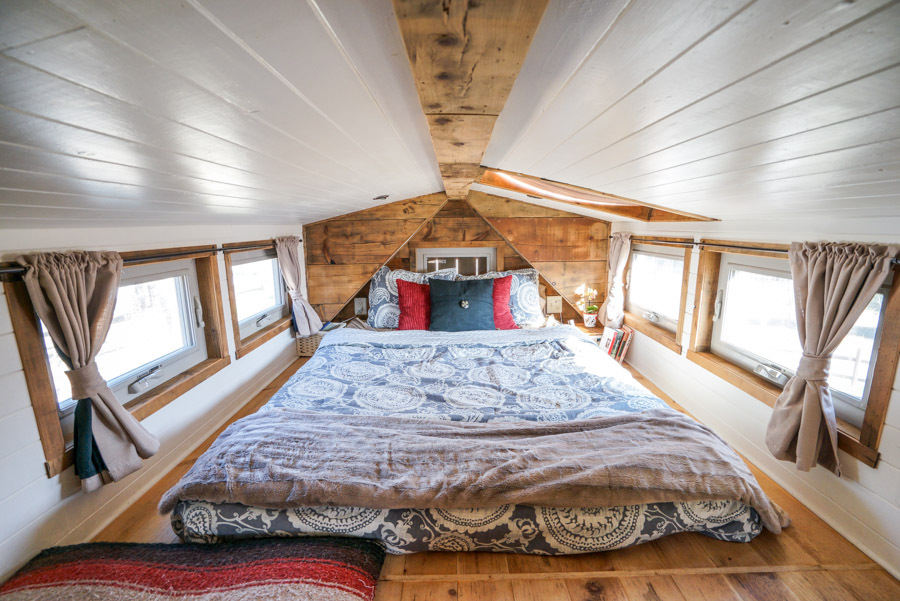
Interior – Loft


Interior – Shower

Interior – Toilet

Construction

Construction

Storage couch in action

  • Storage staircase in action

Always on the road

In Arizona’s Painted Desert

Tiny House Giant Journey

Petrified Forest National Park, Arizona

Parked at The Wedge brewery in Asheville, North Carolina

Tiny House Giant Journey

The 6 Best Time-Tested Remodeling Projects — and the Worst

Although kitchens and bathrooms always steal the spotlight in a home remodel, they aren’t necessarily the ones that have the highest return on investment when you sell your home.

Since 2002, trade magazine for contractors and builders “Remodeling” has been tracking how much it costs to do common home improvement projects — and then calculating how much of that cost is recovered when the home sells.

But this year, we decided to focus not just on the new data, but how projects have performed since 2002.

So, what’d we find?

Well, you may want to reconsider turning that spare room into a full-fledged office. A home office remodel had the worst overall ROI of 52.6%. The project’s been declining since it was added to the study in 2005 with an ROI of 72.8%.

The biggest jump we’ve seen? Backup generators, which had some of the lowest ROI rates over the years — as low as 47.5% in 2011 — leapt to 52.7% in 2012 and then took an almost 15 point jump to 67.5% in 2013, thanks to Hurricane Sandy and extreme weather.

When weather and the demand for generators calmed last year, ROI dropped to 59.9%. Overall, backup power generators come in second-to-last in our check on the history of the “Cost vs. Value Report.”

But the real gems are those projects that don’t have such highs and lows — the ones with consistent ROI.

We’re not saying these steady and reliable projects are the ‘right’ ones for you. If a home office will improve your quality of life and help you enjoy your home more, then it makes sense. We just think knowing what’s going to happen with your remodeling dollars makes sense, too.

So, which ones are the long-term winners? The projects that share these four characteristics:

  • Low-maintenance
  • Good — but not necessarily the highest — quality
  • Energy-efficient
  • Not too costly


1. The Highest ROI: Replacing Your Front Door

Year in and year out, no single project has provided such a healthy return on your home improvement dollar as a new front door. A replacement steel door averaged a 98% return on investment — by far the highest return in our historical look at the “Cost vs. Value Report.”

It’s also the lowest-cost project in the annual report at $1,230. It’s an energy upgrade that has great curb appeal and needs virtually no maintenance.

“It gives you the best bang for your buck in terms of transforming the look and feel of your home,” says Brandon Erdmann, president of the remodeling firm HomeSealed Exteriors in Milwaukee. “Plus, old exterior doors can be a huge source of energy loss. So you’re improving the look of your house, improving energy efficiency, and you’re able to do it without breaking the bank.”


2. New Siding

No other feature has as much impact on curb appeal as siding. Clean, well-cared-for siding signals home improvement mastery. Old, worn siding can contribute to a loss of up to 10% of your home’s value.

That’s one reason new siding has such a high ROI. In fact, of the top 10 long-term averages from the “Cost vs. Value Report,” three of them are replacement siding projects.
The Top 10 Projects for Long-Term ROI

Project Long-Term ROI
Entry door replacement (steel) 98.0%
Siding replacement (fiber-cement) 83.9%
Minor kitchen remodel (midrange) 81.8%
Siding replacement (vinyl – midrange) 81.5%
Garage door replacement (midrange) 80.7%
Deck addition (wood) 80.6%
Siding replacement (foam-backed vinyl) 79.5%
Attic bedroom remodel 79.3%
Window replacement (vinyl – midrange) 78.6%
Bathroom remodel (midrange) 77.1%

Vinyl siding is low-cost, durable, and easy to install, hitting all the right notes when it comes to getting a good return on your home improvement dollar. Best of all: It’s a low-maintenance feature that frees up your time. In a 2013 survey of homebuyer preferences from the American Institute of Architects (AIA), respondents voted low-maintenance products the most popular characteristic of home design — a preference that’s trending up from previous AIA surveys.

Today’s vinyl siding includes fade-resistant finishes and transferrable lifetime warranties that are much more confidence-inspiring than the 10-year guarantees of just two decades ago. Over time, midrange vinyl siding replacement projects have returned 81.5% on the initial investment.

Fiber-cement siding also shows a strong ROI, with the second-best return of any project in our long-term look at the “Cost vs. Value Report” — 83.9%. Although it’s more expensive than vinyl, it has one thing vinyl still lacks — the perception of quality.

That’s important to homeowners and homebuyers. In a survey from the National Association of Home Builders (NAHB), “quality” was the one of the most important traits that homebuyers focused on when shopping for a house.

Foam-backed vinyl is another winning project, with an average long-term return of just under 80% and a cost that’s slightly more than fiber-cement. But foam-backed vinyl has a trick other sidings don’t — it’s an energy-efficient upgrade, with an R-value of R-2 to R-3.

During a research project on residential energy efficiency conducted by the technical analysis firm Newport Ventures, homes clad with foam-backed vinyl siding showed an average energy savings of 5.5% over a two-year period.

That’s music to any homeowner’s ears. According to the AIA, energy-efficiency is the second most popular characteristic of home design — a feature that helps you save money for years to come.

3. Minor Kitchen Remodel

We’re not talking about the dream kitchen remodels that are plastered on Pinterest and Houzz. Those types of remodels took a big hit on ROI during the recent recession. But a minor kitchen remodel weathered the economic bumps with an average return of 81.8% over the years, helped by a relatively modest financial commitment — the 2015 “Cost vs. Value Report” pegs the cost at $19,226 (that includes labor and new cabinet doors and drawer fronts, countertops, flooring, and appliances).

Recession or not, a minor kitchen remodel beat out a higher-end kitchen remodel every single year, with its highest recorded ROI at 98.5% in 2005.

“People are always willing to update their kitchens,” says Dale Contant, secretary of the National Association of the Remodeling Industry (NARI) and owner of Atlanta Build and Design. “It’s the hub of the home.”

That’s underscored by stats from Harvard’s Joint Center for Housing Studies that show that over the last 10 years, homeowners have spent more on kitchen remodeling than any other home improvement category.

That indicates homeowners don’t seem to be as concerned about the ROI on a kitchen remodel as they are about how the kitchen works for them personally, and maybe a bit about injecting their own personalities into the hub of the home. A 2013 survey from NAR found that 53% of buyers undertook a remodeling project within three months of purchase, and of those, 47% dug right in and remodeled their kitchen.

4. Wood Deck Addition

Deck additions have been popular projects with a high ROI but, like a lot of investments, decks fell off during the recession.

“When the economy soured, deck-building soured,” says remodeling contractor Lino Carosella of Haverton, Pa. “Decks are a bit of a luxury, and homeowners tended to spend on necessities, such as upgrading their kitchens and baths. But now decks are coming back.”

Indeed they are, in they past two years vaulting over bathrooms and other improvements on our list of long-term winners with an average ROI of 80.6%. Although homeowners annually build about twice as many patios as decks, both outdoor projects benefit from our ever-increasing love of outdoor living, a trend that looks to continue for the foreseeable future.

One big reason is that decks and patios are a sweet way to expand living space at a low cost of $8 to $30 per square foot — a bargain compared to the $150 to $300-per-square-foot cost of a new home addition.

5. Attic Bedroom Remodel

Attic bedroom remodels join our list of smart investments with an overall ROI of 79.3%. Attic conversions were especially popular during the recession, when homeowners put off buying move-up houses and instead turned to increasing the living space they already owned. Makes sense with the rise of multi-generational households over the past few years.

Converting an attic to a bedroom increases living space without increasing your home’s footprint — the walls, floor, and ceiling already exist — which helps keep remodeling costs under control.

6. Garage Door Replacement

Steel

Image: Clopay Building Products

No surprise that a garage door replacement project made it onto our list of all-time winners — a new garage door provides a big boost for your home’s curb appeal. In fact, of our top 10 long-term champs, most are exterior projects that ramp up your home’s good looks and enhance marketability.

A project that replaces an older, two-car door with embossed steel door has a current cost of about $1,600. Over the years, midrange garage door replacement projects have returned a healthy 80.7% of a homeowner’s investment.

A Note on Projects That Are Trending Downward

Why aren’t home office remodels as popular as they were 10 years ago? Probably because we’ve come to rely less on dedicated office space and more on mobile hardware that lets us conduct business from any room in the house. Cloud storage puts documents a click away — not in a file cabinet — and our smartphones keep us connected 24/7, not just when we’re in the office.

That sensibility frees up spare rooms for other uses, especially bedrooms, bathrooms, and storage.

Another project, sunroom additions, appears to have gone the way of sunken living rooms and parlors. They used to be fashionable, but today we know sunroom additions are difficult to heat and cool, and, at $300 to $400 per square foot, they’re expensive to construct.

You’ll get almost the same benefits — and more fresh air — with a much cheaper to build deck or patio.

The Bottom Line

It’s true: A rising tide lifts all boats. Over the past couple of years the stabilizing economy has helped produce better returns on most remodeling projects.

That’s good news for homeowners, who can be assured that their remodeling dollars are garnering better returns when it comes time to sell, and generating more enjoyment of their homes in the meantime.

Happy remodeling!

John_RihaJohn Rihahas written seven books on home improvement and hundreds of articles on home-related topics. He’s been a residential builder, the editorial director of the Black & Decker Home Improvement Library, and the executive editor of Better Homes and Gardens magazine.