So, you’ve found your dream home and you’ve nearly made it through the home buying process. You’ve made an offer on a house, you’ve gotten approved for a mortgage, and you’ve conducted a home inspection. Now, it’s time for closing. So, what happens at a closing on a home?
In the below video, real estate professional Jessica Edwards with Coldwell Banker Sea Coast Advantage explains the closing process.
Whether you’re just starting your home search, or getting ready to move to your next home, home begins at coldwellbanker.com.
If you have any questions, please call, Chris Maroc 914-215-2025
Getting ready to sell your house? We asked our global Coldwell Banker network for their best advice for those prepping their homes. Check out what they had to say.
Get Inspected
“Get the home inspected and address any necessary repairs now before it becomes an issue during negotiations.” says Susan Heckman, Marketing Coordinator for Coldwell Banker Residential Brokerage. At the same time you should also check with your town to ensure there are no open permits on your home.
Believe me, I know how scary the word inspection is but this is one of those things that will hang over your head until it gets done. Make the appointment and get it off your mind now.
Curb Appeal Matters
The first impression of your home is incredibly important. Buyers who have the ability to do a “drive by” will and if what they see on the outside doesn’t look good then chances are they are going to skip on checking out the inside.
“Buyers sense “Pride in Ownership” from the moment they drive up and want to be the people who love their home. Make it feel like a place to “come home from work to”, “raise a family in”, “retire into.” It’s important to demonstrate the benefit of the features, not the features themselves. That’s what HOME is all about. Convey the dream.” –Alec Schwartz, Coldwell Banker Preferred
Stand in front of your house and determine what areas of your front yard and home look tired. For some it might just require quick fixes. For example, “a quick coat of paint will make your entrance sweet and inviting” says Teresa Congioloso withColdwell Banker Pryor Realty, Inc.
Whatever it is that your home needs start thinking about it now. “Start clearing away the outside from any winter debris. Getting the home ready for a beautiful spring yard takes time, and shouldn’t wait until its already spring to start” says Lauren Lehr from Coldwell Banker Conroy Marable Holleman. Once you do the work have your real estate agent come over and take the listing photos, that way your hard work is captured on camera and your home is presented to potential buyers at it’s very best.
Andrea Geller, with Coldwell Banker Residential Brokerage in Chicago, suggests removing all signs of winter. “Once you have removed dead foliage from the outside, bring your attention to the inside. Get rid of auxiliary heaters. If you live in a condo make sure the hallways have been cleaned of trails of salt from boots. The remnants of winter in the common areas give the impression to potential buyers that the association does not properly maintain the building.”
Take this time to swap out your seasonal decor. For example, put away the heavy blankets and bedspreads, swap out boot trays for throw rugs and consider adding some bright floral arrangements.
De Clutter AKA Minimize
“Remove the clutter, potential buyers for your house need to be able to visualize it as their home. By removing a few items of furniture you don’t necessarily need, some extra kitchen appliances from on top of the counters, and pictures. As strange as that last one sounds, your buyers don’t need to feel as though the eyes in the pictures are watching them!” says Scott Vinson II with Coldwell Banker Royal Realty.
As you declutter, you can pack away items you won’t need until after your move and donate or trash things you no longer want.
A Fresh Coat of Paint Goes a Long Way
Painting is one of the best things you can do to prepare your home for sale. According to HomeGain’s Prepare to Sell 2009 national survey, the average price to paint interior walls is $500 to $750, but that increases a home price by an average of $1,500 to $2,000 — which can be a 250 percent return on investment.
“Don’t be afraid to use color” say Matthew Rathbun from Coldwell Banker Elite While neutrals are the safe route to go, nice flat colors and accent walls give a home character. Gray has becoming an increasingly popular trend as well.
Clean Up (Or Hire Someone to Do It!)
Imagine walking into a home smelling last night’s dinner, seeing mold on the bathroom tile and pet hair dust balls the size of desert tumbleweeds? Yuck!
A clean home will help your home sell much faster. If getting down and dirty just isn’t your thing then you can always hire someone. If you plan on doing it yourself, “remember the small details like based boards, door trim and light switches” says Lisa Heglar from Coldwell Banker Sea Coast Advantage. We also suggest getting your carpets professionally cleaned.
Set a Budget
Items that you put off fixing or upgrading may be back on your radar now that you will need to present your home in it’s best light. Before you go breaking that piggy bank and completely remodeling your kitchen check out this post on How to Limit Spending When Getting a Home Ready to Sell
Get Inspiration from Other Sellers
Unless you are a professional interior decorator, staging your home will not come naturally. Check out what hundred of other homeowners just like yourself have done to make their homes “market ready” by browsing through these thousands of photos.
When your home has a place for everything it is magical. You open up cabinets to neat piles of Tupperware. Your closet is organized with shoes, belts and accessories organized in a way that would give Carried Bradshaw envy. Your garage is neat and each tool is hung with care while your children’s toys are lined up and ready to be used at their convenience.
Let’s be serious, there are very few who can actually say their home has enough space for all of their things. In the battle of you vs square footage, you rarely feel like you come out on top. Here are some awesome ideas to get you get organized and find a “home” for all of your things.
Underneath Steps
Don’t let that space underneath your stairs go to waste. Depending on the size available you may even be able to create a small office like the image in the bottom left.
Images via shelterness, artemendoza and homedit
Inside Cabinet Doors
The inside of cabinet doors are hidden which makes them a perfect place for storage. We especially love the idea for the spices below.
Images via iheartorganizing, Houzz, Instructables & thesepreciousdays
Up!
Look up and you will be amazed at all of the places you can find to store things. From the garage ceiling to the space above doors, it is important to use every inch without making a room feel cluttered.
Images via dgdoors, accentondesign, flor & marthastewart
Underneath Your Counters
If you have a smaller kitchen you know what it is like to open up a cabinet and have things fall onto you…it’s miserable. Clear up some space by taking advantage of the area underneath your counters.
Images via thedesignfile, kellysthoughtsonthings, stashvault & kitchenstuffplus
Moving? Let’s be honest, moving is stressful. But, imagine if you can’t read, understand all of the chatter around you and all you see is the chaos of boxes, your home in an upheaval and stressed out humans everywhere. Sounds even more stressful, right? That’s why it is vital to look after your furry friends during the moving process.
Moving doesn’t have to be a dog-gone cat-astrophy. The good news is that with a paw-ful of wise tips you can ease their trauma. Here are ten tricks that have been approved by Dr. Sara Sheltren, veterinarian at the East Padden Animal Hospital, in Vancouver, Washington to keep Fluffy and Fido cared for during the moving process:
Before Moving Day: Become familiar with pet rules and regulations. Landlords and homeowners’ associations may have specific pet rules. Become familiar with your new area’s leash laws, pet ordinances and/or pet licensing requirements. Your pet may need additional vaccinations, medications or certain certificates depending on where you are moving. A call to the local animal control facility should answer your questions.
Talk To Your Current Vet:Your veterinarian is a great resource. If you have an animal that dislikes traveling, your vet can suggest behavior modification techniques or medication that can make traveling less stressful for your pet. When talking to your vet, also discuss getting Fluffy or Fido micro-chipped. Dr. Sara Sheltren, a veterinarian at the East Padden Animal Hospital says getting pets’ identification microchips can be a vital step in reuniting pets with their owners.
Find A New Vet: Find a new vet in your new area before moving day. Your current vet may be able to make recommendations for colleagues he or she knows in your new area. When finding a new vet, it is recommended to set up an appointment as soon as you move in order to get established. It always important to make sure you are comfortable with their practice before they are needed in an emergency.
Get Medical Records: Before you leave your old home, make sure you get a copy of all of your pet’s medical records to give to your new vet and be sure to find the closest emergency animal hospital and keep that phone number handy.
Update Your Address: Don’t forget to have new identification tags with your new address and phone number made for your pet’s collar, and if your pet has an identification microchip, remember to update your contact information in the database. Dr. Sheltren also recommends carrying a picture of your pet with you in case they get lost.
Keep Things Normal:Instead of pulling an all-nighter to pack, try to pack over a long period of time so that your pet thinks everything is normal. This will keep their stress level down. If you are moving with cats, it can help to bring out their carriers out a few a weeks before the move. Put their favorite treats and toys inside their carriers so they can get used to it before the big moving day. Don’t pack the food away! Keep your pet’s food, water, bowls, medication and any other important supplies (like that favorite squeaky toy) off the moving truck and with you.
Moving Day: During the actual moving day, where boxes and furniture are being moved, pets should be removed. Find a friend who wouldn’t mind pet sitting or find a place away from all the noise of moving such as a doggy day care or cat care center. If you can visit them during a spare moment, it can help reassure the pets that nothing is going on.Keeping pets locked away in a room during moving day can make them anxious from all the noise and new people that might be in your home. If you must keep them locked away, find a quiet room, water bowl and put a HUGE sign on the door.
Travel with Your Pet:Unless your move is long distance or international, your pet will likely be traveling by car with you nearby. By driving them yourself you can care for them and give them a sense of familiarity as they move. To prepare your pet for this trip, drive for short distances with your pet to prepare them before the final move. Also, remember to plan ahead for any special carriers your pets may need for transportation. There are even special seat belts for large dogs.
Air Travel: If you are moving your pet by air or internationally, check all rules and regulations far ahead of the day you plan to leave and remember to keep your pet’s special documentation at hand.
After Moving Day: Don’t let pets roam around the neighborhood until they are acclimated. Take them out on a leash to explore their new territory and show them how to get home. If you let them out in a new place right away, they might get lost or run away due to stress. Make sure your pet’s new identification tags are secured to their collar.
Now snuggle up with your furry friend and enjoy the new home! Any questions, please call me, Chris at 914-215-2025.
THE URGE TO PURGE: AN INSIDER’S TAKE ON LIGHTENING YOUR LOAD BEFORE YOU MOVE
We’ve noticed that with the onset of the busy moving season comes an onslaught of blog posts and articles offering tips on Making Your Move Easier. And the vast majority of them urge you to Purge! – by having a yard sale or donating unwanted clothes to a worthy organization. A few might suggest using one website or another to attract more attention – and will then without another word on the subject move on to Inform the Post Office of Your New Address!
We like to be more thorough. And because we are fully engaged in the business of moving, we can be. And sometimes – like right now – some of us are knee-deep in the process of moving ourselves.
Emptying a 3-Bedroom House Without Starting a Fire
On all the moves I’ve been on in all the years I’ve been a mover I can count on one hand the number of times the customer didn’t comment on their disbelief at how much stuff they had. My reply was always a commiserative “yes, I know, it’s unbelievable.” Now I find myself on the miserating side and, after a month of packing and selling and donating and giving things away for free, I wonder why I don’t just pile it all up in the backyard, burn it and have a beer.
After a full month of purging and only three more weeks to go before I vacate this house I look around and feel that I haven’t accomplished a thing. There’s still stuff everywhere. It’s a miracle this house didn’t sink right into the ground while we were here. I have gotten rid of a bunch of stuff through various avenues, however. And my giddiness at my (admittedly modest) success compels me to lay out a few things I’ve found to work (or not).
Your mileage may vary, but perhaps the following will make the run-up to your own move a bit less taxing.
“Have a yard sale!”
We’ve gone about this three ways. The first time, we decided at 10pm to have one the next day. So in the morning after wolfing down our frozen waffles we hauled a bunch of furniture and boxes of toys and clothes out into the yard. Surprisingly we made almost $40 – due in large part to the woman who was across the street all day remodeling the home she and her husband just bought. Aside from her and a friend we convinced to come take a look, though, the time and effort brought little.
Our street, mind you, is not a busy one. More traffic might bring more people and more sales. We advise, however, a little more planning.
We announced the next yard sale on craigslist, on the recommendation of the friend who came to the first one and, evidently, felt sorry for us. We also painted YARD SALE with an arrow and our address on large pieces of heavy paper and hung them on telephone poles along the surrounding busier streets. (TIP: a sign written with a Sharpie on regular letter-sized paper is barely visible let alone legible to someone driving by; go big on this or don’t go at all.)
We had a fair few people come by. Most of them slowed down to glance out their window at our yard full of stuff, then continued on down the street and around the corner and out of sight. Still, we made about $60 on the day – half from the woman still remodeling across the street and none from the few people who responded to our craigslist posting.
Our final yard sale strategy has involved leaving everything out there every day for a week on the off chance someone will drive by, see something they like and come knocking on our door offering us cash for whatever caught their eye. This has brought a windfall of dollar bills – from my four-year-old son’s perspective.
Verdict: People are picky about how they spend their singles; you’ll have to put out a vast selection of junk if you want to get rid of any of it.
“Sell your stuff online!”
We’ve tried a few things in this vein, with some decent success for the effort. Craigslist has not been good to us – for months I’ve been trying to sell, among other items, the two Lightning McQueen beds my sons have outgrown (one physically, one emotionally). I got a few inquiries over those months but no takers. I did sell a child seat once. But overall my luck has not been good.
Two weeks ago I got on eBay for the first time ever and listed one of those beds for $35. On the second try it sold for $41. Thank you and good riddance. If I had more free time I’d figure out the shipping on the other items I am putting up for auction; for now I’m staying local and offering free pick-up. Less work, but for a smaller market. I just don’t have the time to go crazy for a $15 Hot Wheels Big “O” Race Track with chargeable car.
What has worked well for us so far involves a Facebook page for a local ‘Moms On A Budget’ club. The competition is fierce; these women sell anything and everything and no sooner have you posted a picture of the desk you’d like to get rid of than three other posts appear, one for a lamp, one for a decorative mirror and six for a total of eleven pairs of “new” shoes, all at deep discount prices.
We created an album of the items we want to sell and keep adding new photos. This means all our stuff can be seen at one time AND each time we upload a new photo or someone comments on an item our album gets bumped to the top of the page, ahead of all the shoes. The drawback so far is having to constantly check for new messages by people interested in this, wanting measurements on that and asking if you will hold that other thing until they can come by after work/school/the country club – and then hoping they don’t flake, which so far has been much more an issue on craigslist.
Verdict: Online selling saves both time and your back compared to setting up a yard sale.
“Donate your unwanted clothing!”
We get these plastic bags in the mail all the time from various organizations asking us to leave our used and unwanted clothes and various other items out by the curb on a specified day for pick-up. These groups seem to be predominantly veteran-related – which sounds great I guess. Unfortunately none of them has offered to haul away the sofa and love seat I can’t seem to pawn off on anyone and I’d rather not have to bring it myself to the Salvation Army or Goodwill. But I would do this sooner than I would leave it for the garbage man. As a society we already produce way too much trash. And there is always someone out there who can use the things you can’t.
Verdict: Giving stuff to people who can use it is clearly more time-consuming but immeasurably more gratifying than giving it to people who will just bury it in the ground or dump it in the ocean.
Whichever route you decide to try, take my advice and get to purging early.
Seriously, no matter how many times you might hear it, you really have no idea how much stuff you have until you have to move it.
Any questions, please call me, 914-215-2025, Chris
It’s official. Summer is over, the kids are back to school and the leaves are beginning to change. October is upon us–the month of crisp fall weather, spooky traditions, and cozy moments at home. Here is what you need to know to get your home ready for the spookiest month of the year.
1. Don’t Fall Behind on Your Garden – Just because the summer months are over, it doesn’t mean that you have liberty to neglect your yard. Spruce up your garden by planting chrysanthemums which bring an added pop of color to the fall landscape. Add a few dried corn stalks to a lamp post or mailbox for natural decor. As for those potted plants that have been living outdoors all summer, start transitioning them indoors now.
2. Reorganize the Garage/Attic – It’s time to tuck the beach toys behind the rakes and shovels. Bring the Halloween decorations down from the attic and stock up on on-sale gardening products for next spring. As always with any reorganization project, be sure to evaluate how much use particular items got this summer. If necessary, donate unused or unwanted items and trash broken tools and supplies.
3. Collect Your Costumes – Decide on a costume early, before the stores are picked over and supplies are low. Try on all the moving pieces to make sure everything fits and make plans for cooler weather, if necessary.
4. Spooktacular Halloween Decor – Halloween is all about making your home spooktacular. That said, it can be easy to do a little too much. Not to worry, we’ve got the guide to decorating for Halloween without going overboard.
5. Touch Down! – That’s right. We’re telling you to watch football. But, before you wave the white flag and surrender to your Barcalounger in front of the flat screen all day Sunday.
6. Champion your Meal Calendar – Now that school is in full swing, your family calendar is crowded with soccer games, Halloween parades and piano recitals. Getting everyone to the dinner table at the same time is an epic challenge. Make dinner prep easier by mapping out your meal plan a week in advance. If you know football practice may run late on Monday, make extra portions on Sunday night for easy heat & eat the next day.
7. Get your Fireplace Ready – This is the time for cozy nights at home by the fire. Make sure your fireplace is ready for those cooler nights.
8. Get Cozy! – Switch out your lighter bedding for warmer, cozier linens. Swap your light down blanket for a heavier duvet, add a faux fur throw blanket at the base of the bed and use linens made of cozier material like flannel or wool. Looking for inspiration for a cozy fall bedroom?
9. Weather Proof your Home – Before the colder months set in, check weather stripping on windows and doors. Also be sure to caulk cracks and gaps in siding.
This can be a tricky question to answer. Partly because our needs change over the years and decades. After kids leave home, maybe smaller is better but prior to that, maybe a bigger home is what you’re seeking–room for the kids, dog, and tons of the kids’ sleepover friends.
The trends reflect our indecisiveness too. Sometimes McMansions are on the rise and then there’s the complete opposite: tiny, tiny homes. In fact, you can watch fascinating shows online about families of four with a couple of dogs moving into these tiny well-designed homes or homes on wheels.
While that small may be far too small, size is a big consideration. It’s also something you should think about before you go house-hunting for that perfect home.
Of course,while there are many personal reasons involved in choosing which size home is the best fit, there are also some very important considerations that can help you decide.
Here are few things to help you weigh your options.
The bigger the home, usually the higher the mortgage. You pay for what you get. It’s likely the mortgage payments will be more. However, a smaller home with more amenities is sometimes not that far off in price from a larger home that gives you a bit more square footage.
Think about if you are planning to stay in the home a long time. If so, getting a bit more square footage now might be better than having to move again in a short period of time when you may outgrow the home.
Decide how much home you’re willing to maintain. For instance, do you want the responsibility of a big back yard or do you want to have something in a planned development, such as a town home, where there is limited yard space to decorate and maintain. That reduced yard size can give you a lot more freedom and leave you with more money in your bank account as opposed to paying for landscaping maintenance.
Do you work from home or might you someday? This is really important these days as more and more people are working from home and setting up desk space on the dining room table is not optimal. If you think you might be working from home someday, look for a home that will have enough space for you to work, even it it’s just a screened-off nook somewhere in the house. No doubt, you’ll find a good use for the space, whether or not you actually work from home
If you want a bigger home but aren’t sure you can afford it, consider your options. Can you get a roommate? Increase your income? Decrease your debt? Or maybe you can wait a little bit longer and save more to get into the home you really want.
The important thing is to think about the size and style of home you want before you start your house-hunting. This will help you target homes that are most suitable for your needs. Be sure to consult with experts to get the best advice and find out how much home you can really afford.
If you are thinking of buying, selling or renting a home, please give me a call at 914-215-2025. Thanks, Chris
The growth outlook was further buoyed by other reports on Thursday showing that in August, factory activity in the mid-Atlantic region hit its highest level since March 2011 while a gauge of future economic activity increased solidly last month.
“The economy is beginning to fire on more cylinders,” said Ryan Sweet, a senior economist at Moody’s Analytic in West Chester, Pa.
The National Association of Realtors said existing-home sales increased 2.4 percent, to an annual rate of 5.15 million units. That was the highest reading since September and confounded economists’ expectations for a pullback.
It was the fourth consecutive monthly gain in sales, confounding economists, who had expected a decline.
In a further encouraging sign, the share of first-time buyers rose for a second consecutive month and more houses came onto the market, which should temper price increases. Earlier stages of the housing recovery were driven by investors.
Housing activity stagnated in the second half of 2013, weighed down by a run-up in mortgage rates and home prices, but it now appears to be regaining its footing. A report on Tuesday showed a surge in home construction in July.
“We are moving back to a more normal market where it’s driven by the fundamentals of confidence in the economy,” said Budge Huskey, chief executive of Coldwell Banker Real Estate in Madison, N.J.
In a separate report, the Labor Department said initial claims for state unemployment benefits fell 14,000 to a seasonally adjusted 298,000 for the week ended Aug. 16. That pointed to a sustained improvement in labor market conditions.
The four-week average of claims, considered a better measure of labor market trends as it irons out week-to-week volatility, rose 4,750, to 300,750. At that level, it is consistent with solid job growth, and claims are back to prerecession levels.
The jobless claims report covered the period during which the government surveyed employers for August’s nonfarm payrolls data. The four-week average of claims fell 8,500 between the July and August survey periods, suggesting another month of relatively strong job gains.
Nonfarm payrolls increased by 209,000 in July, marking the sixth consecutive month that job growth topped 200,000, a sign of strength last seen in 1997.
The firming jobs picture has caught Federal Reserve officials by surprise. Minutes of the Fed’s July policy meeting published on Wednesday showed that officials viewed the improvement in labor market conditions as “greater than anticipated” and hinted that it could lead to an early interest rate increase.
In a third report, the financial data firm Markit said its preliminary manufacturing purchasing managers index for the United States rose to 58 this month, the highest point since April 2010, from 55.8 in July.
That show of strength was corroborated by a separate report from the Philadelphia Federal Reserve Bank, which showed that its business activity index increased to 28.0 this month, the highest point since March 2011, from 23.9 in July. Any reading above zero indicates expansion in the region’s manufacturing.
“Over all, today’s Philly Fed and Markit manufacturing surveys indicate continued healthy growth in the manufacturing sector in August,” said Dean Maki, chief United States economist at Barclays in New York.
Moving to a Smaller Home, and Decluttering a Lifetime of Belongings
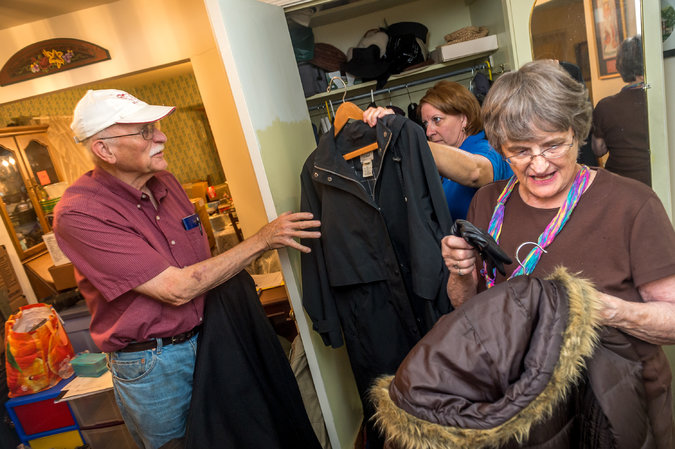
Wendel and Carolyn Thompson are assisted by Jewel Flick, center, of Let’s Move, a downsizing and moving specialist.CreditJ.M. Eddins Jr. for The New York Times
THE amount of goods a couple can accumulate over 44 years living in the same house can be overwhelming. And that is what Wendel and Carolyn Thompson, of Columbia, Md., have been grappling with since January as they prepare to leave their split level and move to a retirement community this month.
Figuring out how to squeeze the contents of a house into a two-bedroom retirement unit nearby in Catonsville, Md., has taken most of their time in recent months. And they’ve had some help. “Declutter ladies,” or downsizing specialists, spend hours with them every week to sort through and pare down their belongings to a more manageable size.
Photo
Jewel Flick, left, of Let’s Move, is helping the Thompsons prepare to move. Wendel Thompson, right, checks the value of donated items on a computer.CreditJ.M. Eddins Jr. for The New York Times
“One of my recommendations for handling this,” she added wryly, “is don’t wait.”
But, of course, many people do wait — and wait, said Kimberly McMahon, co-owner of Let’s Move, a downsizing and moving specialist in Fulton, Md., whose company is helping Mrs. Thompson and her husband, 78, a former government statistician, to clear out every nook and cranny.
“Downsizing is the hardest because it is emotionally difficult for people to release their history,” said Ms. McMahon. “It’s the worst anxiety associated with any move.”
Her advice is “that nothing should be off limits. Either use it, love it — or leave it.”
Getting rid of furniture and general clutter can be a daunting task. For those with antiques, silver, jewelry and other valuables, Laurene Sherlock, a Bethesda, Md., antiques appraiser, will advise people of outlets like vintage shops, where owners can consign their precious pieces for sale.
But the value of valuables can be cyclical, warned Ms. Sherlock, who noted that 1950s and mid-modern furniture “is hot, and so is Bakelite jewelry, but something else that people love may just not be popular. A lot of younger people just don’t want to be burdened with the tchotchkes.”
While homeowners can amass impressive amounts, the task of clearing out apartments where people have lived for a long time is not any easier, said Ron Shuma, who runs A+ Organizing in New York City.
“I advise going through each drawer and each closet every six months because it’s so much easier,” he said. “But people typically don’t, and that’s where I come in to help people realize what are treasures, and then we get rid of the rest.”
When Hanan Watson, 71, decided to downsize after 35 years in a large two-bedroom Murray Hill apartment, she found that “it is very difficult to sell or even give away many things. Charities can be extremely particular about what they are willing to take.”
She donated some of her art to a nearby community art center, gave some items to relatives and friends and got a lot of assistance from Mr. Shuma in getting rid of larger furniture.
“There are a lot of challenges, for example, the glut of ‘brown furniture” — even good-quality mahogany — which fetches pennies on the dollar,” Mr. Shuma said. “The best thing is for a family member to take it.”
But with careers and young children, fewer 40- or 50-something offspring want to acquire bulkier items or take on the task of sorting and disposing of unwanted goods in their parents’ homes. In the last decade, baby boomers, more used to paying for services than their Depression-era parents, have been increasingly willing to spend money for outsiders to help them pare down their accumulation.
The price of such services can vary widely, from $60 an hour in major metropolitan areas except New York City, where the cost can run as high as $200 hourly. In other areas, downsizing help can run $40 an hour. Sorting, packing and moving typically runs from $4,000 and $10,000, depending on the locale, according to specialists.
Despite the cost, the demand for downsizing is strong, according to the National Association of Senior Move Managers. In 2014, the association reported that 50 percent of those contracting for services with its members were older adults, and 30 percent of the initial contacts leading to contracts were from the senior’s family.
An additional 20 percent of business comes from sources like senior housing communities, which have increasingly been establishing programs to help seniors pare back and streamline their belongings before becoming community residents. In 2007, Erickson Living, a major retirement community provider, started a program in Novi, Mich., to advise older adults who had signed up to move to the Fox Run retirement community.
The program, called Erickson Realty and Moving Service, is offered at the 18 Erickson retirement communities around the country, and helps older people with real estate agents, repair people, organizers and movers to smooth their path out of their longtime homes and into smaller spaces.
Last year, the program helped 230 of the 340 people who moved to Erickson properties in Virginia and Maryland, said Sharon Baksa, its regional sales director. The program provides up to $2,000 in relocation expenses — sometimes more.
“We play the role of the surrogate family member,” said Ms. Baksa, who helped start the program in Michigan. “We handle between 1,800 and 1,900 moves a year over all.”
Choosing the retirement community, the Charlestown Retirement Community in Catonsville, helped the Thompsons in Maryland focus on sorting and jettisoning belongings.
“When we set an August date then we knew we had a goal, and we had to meet it,” Mrs. Thompson said.
The downsizing credit was an incentive for the Thompsons, who started in February with a once-a-week visit, for three to four hours, to help sort belongings and get unwanted items out the door. By April, they had increased the declutterer’s schedule to twice a week to meet their target of an August move, and preparing their house for sale by the fall.
They did not have high-end valuables that would warrant an estate sale, but, instead, had one yard sale and then gave away many of their items to family, friends and charities like Goodwill and Habitat for Humanity. Most retirement communities and organizing professionals maintain a list of organizations and what they will accept.
Churches or temples also help. Marc J. Rosenblum, a retired lawyer and economist, has been clearing out his late wife’s belongings and various household goods from his McLean, Va., contemporary home with advice from his synagogue, Temple Rodef Shalom.
“They provided suggestions for where to allocate items, for destinations like a homeless shelter in Bailey’s Crossroads, Va., and a nearby thrift store,” said Mr. Rosenblum, 78. He first consulted a downsizing specialist, which, he said, “saved a lot of time, and helped me pick up some good ideas, including a furniture auctioneer.”
He handled the downsizing task largely on his own, but others like the Thompsons say they welcome the help and the prompting for what many see as an onerous, time-consuming job.
Even with the help, “it’s one step at a time,” said Mr. Thompson. “And I don’t see the end yet.”
For people thinking about beginning the task, here are some ideas from Kimberly McMahon, of Let’s Move..
■ Write some organizing time on your calendar.
■ Set a timer to get started.
■ Start small, even if it’s matching up a cup with a saucer.
■ Get a friend to help.
■ Fill a trash bag once a week.
■ Call and book a donation pickup for the next day.
Please call me if there is anything I can do to make your move easier, Chris Maroc, Coldwell Banker Residential Brokerage, 914-225-2025


 Moving? Let’s be honest, moving is stressful. But, imagine if you can’t read, understand all of the chatter around you and all you see is the chaos of boxes, your home in an upheaval and stressed out humans everywhere. Sounds even more stressful, right? That’s why it is vital to look after your furry friends during the moving process.
 nd articles offering tips on Making Your Move Easier. And the vast majority of them urge you to Purge! – by having a




 chris maroc